Quantum computing in Malaysia: where should a business begin?
Contents
Quantum computing attracts attention because it suggests new ways to approach certain kinds of computation. For a business in Malaysia deciding whether to do anything about it, the useful question is not “when will quantum replace our systems?” It is “which of our problems, if any, justify exploring quantum methods, and what should we do about security in the meantime?”
This guide answers that in plain terms: what today's machines can and cannot do, the two separate reasons a business might act now, and what a sensible first project looks like.
What a quantum computer is, briefly
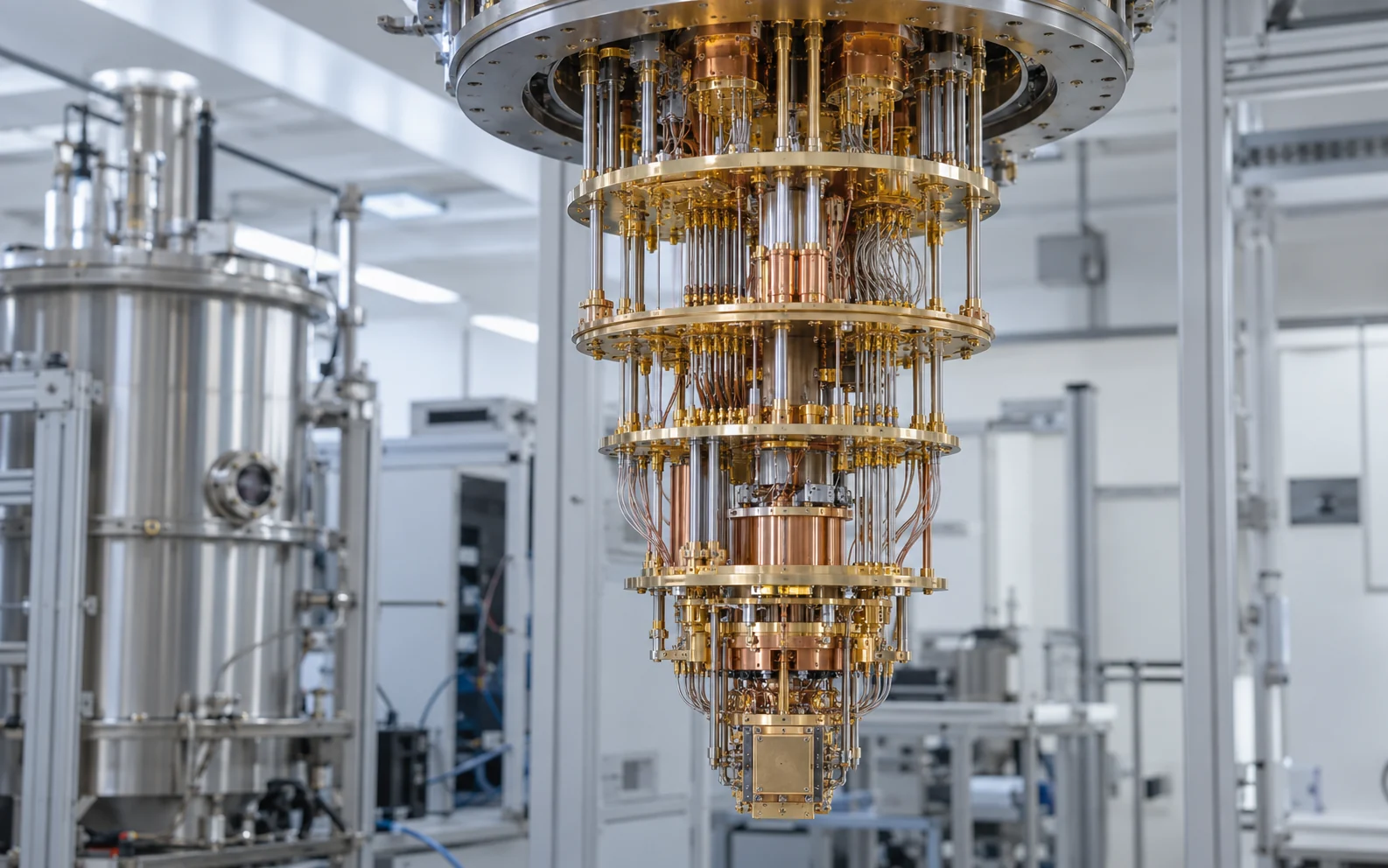
A classical computer stores information in bits, each 0 or 1. A quantum computer uses qubits, which can be in a superposition of 0 and 1 and can be entangled with one another, so that the state of a group of qubits cannot be described one qubit at a time. A quantum algorithm uses interference to make wrong answers cancel out and right answers more likely when the qubits are measured. For a few problem types this gives a proven or strongly expected speed-up over the best known classical methods. For most everyday computing it gives none.
There are two main hardware approaches. Gate-based machines run circuits of quantum logic operations and are, in principle, general purpose. Quantum annealers are specialised: they look for low-energy states of an optimisation problem written in a particular form, which we explain in classical, quantum-inspired and hybrid approaches compared.
Where the technology is today
Today's machines are what researchers call NISQ devices, for noisy intermediate-scale quantum, a term introduced by the physicist John Preskill in 2018. Their qubits are limited in number and error-prone: they lose their quantum state quickly, and every operation adds noise. Large, reliable computations need quantum error correction, which combines many physical qubits into each logical qubit. Error-corrected, fault-tolerant machines are the goal of the major hardware programmes, but they are not yet available for routine business use.
So claims of quantum advantage need careful reading. Demonstrations so far have mostly used problems chosen to show a quantum effect, not business workloads, and in several cases improved classical methods have later narrowed or closed the gap. For most commercial optimisation, simulation and machine learning problems, no practical quantum advantage has been shown.
Two reasons to act now, and they are not the same
The first is security, and it does not involve buying a quantum computer. A large enough fault-tolerant quantum computer running Shor's algorithm could break the public-key cryptography most systems rely on today, including RSA and elliptic-curve schemes. Nobody can say exactly when such a machine will exist, but encrypted data captured today could be stored and decrypted later, a risk known as harvest now, decrypt later. Symmetric encryption such as AES is less exposed, and longer keys are the usual response.
In August 2024 the US National Institute of Standards and Technology (NIST) published its first post-quantum cryptography standards: FIPS 203 (ML-KEM, for establishing keys), FIPS 204 (ML-DSA, for digital signatures) and FIPS 205 (SLH-DSA, a hash-based signature scheme). Post-quantum algorithms are classical: they run on today's computers and are designed to resist attack by quantum ones. Preparing means knowing where your organisation uses public-key cryptography, which data must stay confidential for many years, and which systems and vendors will need to change. That is a security programme, and it can start now.
The second is opportunity: problems in optimisation, simulation or sampling where quantum methods may one day help, and where framing the problem well pays off today whatever the hardware does. That is where readiness work sits.
Four readiness questions
- Do we have an optimisation, simulation or security problem that is well defined and measurable? A vague ambition cannot be benchmarked.
- Can a strong classical baseline solve it adequately? Modern solvers are very good. If one already meets the business need, the case for anything else is weak.
- What data, skills and infrastructure would experimentation need? Clean problem data, people who can formulate the problem, and access to solvers or quantum hardware, usually through cloud services.
- What is the cost of waiting, against the cost of learning now? For cryptography the answer is usually to start. For optimisation it depends on how much a better solution is worth.
What a sensible first project looks like
A first project should produce evidence and a decision, not an inevitable quantum deployment. In practice:
- An inventory of candidate problems, with their business value and how they are solved today.
- A strong classical baseline for the most promising one, measured on real data.
- Where it fits, a quantum-ready formulation of the same problem, tested with quantum-inspired solvers on classical hardware and, only where meaningful, on quantum hardware or simulators.
- A written stop or go decision, with the evidence behind it.
Often the result is a better classical solution and a team that can judge future quantum claims for itself. That is a good outcome.
Where REKA stands
REKA's quantum work is an emerging research and advisory direction, run as applied research in the Lab. It began with learning. In 2022 our co-founder completed two MIT xPRO online courses, Introduction to Quantum Computing and Quantum Algorithms for Cybersecurity, Chemistry and Optimization, and in April 2023 he attended the Quantum.Tech APAC conference in Singapore. That story is told in REKA's quantum journey.
We do not build quantum computers, we have not deployed a quantum solution, and we do not claim a quantum advantage. What we offer is the method set out on the Quantum Lab page: frame the problem, benchmark it honestly against classical methods, and say plainly if classical wins.
Questions readers ask
Do we need a quantum computer to become quantum-ready?
No. Readiness is about understanding your problems, your cryptography and your data well enough to act when the technology matures. Most of the work runs on ordinary computers.
Is post-quantum cryptography a quantum technology?
No. Post-quantum algorithms are classical algorithms that run on today's hardware. They are designed to stay secure against attackers who have quantum computers.
What is quantum-inspired optimisation?
Classical methods that borrow formulations or ideas from quantum physics, such as solving a problem written as a QUBO or Ising model with simulated annealing. They run on ordinary hardware. Our article on quantum-inspired and hybrid approaches explains how they compare.
Further reading
- Quantum Lab: frame first, win classically today, an honest horizon
- REKA's quantum journey
- Quantum readiness: classical, quantum-inspired and hybrid approaches compared
- Consulting and advisory, where a readiness assessment starts
- The REKA Lab and its experiment record
References
- National Institute of Standards and Technology (2024). Module-Lattice-Based Key-Encapsulation Mechanism Standard. FIPS 203. doi:10.6028/NIST.FIPS.203
- National Institute of Standards and Technology (2024). Module-Lattice-Based Digital Signature Standard. FIPS 204. doi:10.6028/NIST.FIPS.204
- National Institute of Standards and Technology (2024). Stateless Hash-Based Digital Signature Standard. FIPS 205. doi:10.6028/NIST.FIPS.205
- Preskill, J. (2018). Quantum Computing in the NISQ era and beyond. Quantum, 2, 79. doi:10.22331/q-2018-08-06-79